
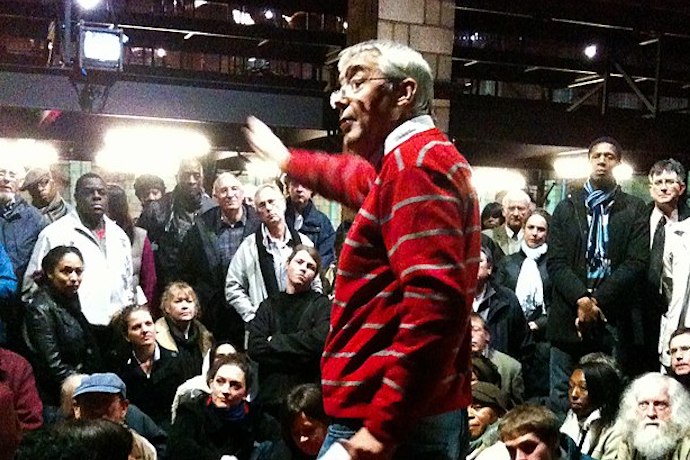

In this week’s Substack newsletter, I’m sharing something quite special: an interview with the late opera director Graham Vick, that took place in 2014, seven years before his life was claimed by Covid. I’d originally intended to publish this as part of a feature about site specific opera. Being young and profligate, however, I ended up interviewing too many people, leaving me with more material than I could use. As a result, Vick’s interview never made it into the final piece.
And what a shame, because there was nobody in the arts better positioned to speak about the topic. As a groundbreaking opera director and the founder and artistic director of the Birmingham Opera Company, Vick was celebrated for bringing opera into the 21st century. Under his leadership, Birmingham Opera became known for its site-specific operas — productions staged outside traditional opera houses, using unique venues around Birmingham.
Often involving large casts, his productions drew on the architectural and social context of the venues, making challenging operas seem relevant and accessible. One notable example was the 2012 world premiere of Karlheinz Stockhausen’s opera “Mittwoch aus Licht,” which Vick staged at the Argyle Works – a former chemical factory in Digbeth, Birmingham. But over the years Vick also breathed new life into classics, using spaces such as a burnt-out ballroom above Birmingham’s old Bullring shopping centre, and disused industrial premises throughout the city.
In our conversation, Vick offered a vehement defence of site-specific opera, challenging those who dismiss it as a mere gimmick. I’m glad that, four years after Vick’s death, I’ve found the opportunity to share his thoughts.
What do you value about site specifc opera?
It separates the art form of opera from the places people associate it with and unlocks it from the trappings of what people consider to be a traditional opera house. When I started [putting on site specific operas ] it was to examine the relationship between the audience and the performer; I wanted to put the audience in the middle of the performance. And the advantage of using found spaces is that they themselves have a life, a history and a humanity to them because they have seen a slice of life: people have worked in them; died in them; had accidents in them. They are not a temple of art; they are part of the world. I find that satisfying and stimulating.
Does it frustrate you that the production can’t be replicated or packaged for another location?
No. There’s far too much product opera; far too much supermarket processed cheese opera, with people taking productions off shelves and travelling from theatre to theatre with no sense of the place that they’re born in, or the place in which they belong…