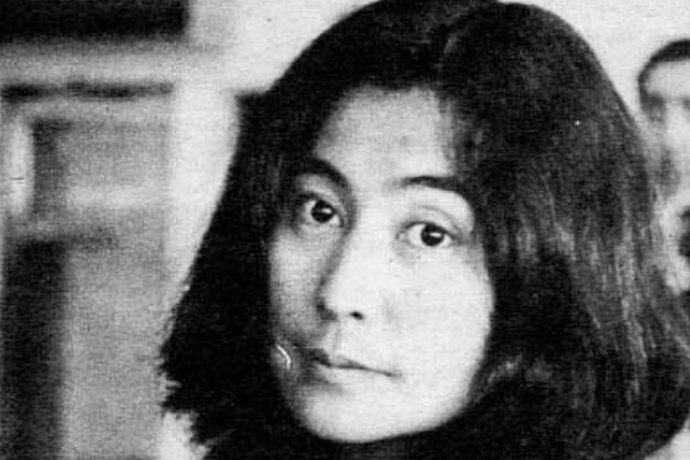

“[Yoko Ono is] the world’s most famous unknown artist: everyone knows her name, but nobody knows what she does.” – John Lennon
When most people think of Yoko Ono, the perception is of the girlfriend who broke up The Beatles. However, Ono is arguably one of the most influential (but misunderstood) multimedia artists of the 20th and 21st centuries. Born in Tokyo in 1933, Ono’s career has spanned over seven decades, encompassing work in avant-garde art, interactive performance, music, acting, and activism. While her later career is inextricably linked with the work of her husband, John Lennon, Ono’s individual artistic legacy is vast and inventive, establishing her as a pioneer in conceptual and performance art. Today, Ono is recognised as a key figure in the development of the Fluxus movement, organising feminist and anti-war activism, and pushing the boundaries of experimental art and music.
What is her style?
Ono’s style is defined by its radical simplicity, emotional directness, and the notion that art is an active process, famously saying that she regards it as “a verb, rather than a noun.” Dissolving the boundaries between artist and audience is the unifying concept in all her works, as Ono’s creativity is utilised as a tool for spreading messages of protest, healing, and peace. Growing up in Tokyo during the Second World War, Ono witnessed hunger, displacement, and devastation firsthand, later saying it was in these years that she developed her “aggressive” attitude. This tension between ruthlessness and fragility also sits at the root of her work, with the insistence that peace is not a passive process but something we must all consciously build.
How did she train?
Although Ono received a traditional education during her childhood in Japan, studying at one of Tokyo’s most elite schools, her artistic training was largely self-directed. In 1951, Ono became the first woman to be accepted into the philosophy department at Gakushuin University, but she left after two years to join her family in New York, where she continued her studies at Sarah Lawrence. In 1957, she dropped out of college, as Ono describes in an interview with Barbara Rose, “I just thought that was so crazy to stay there, because exciting things were happening.” Immersed in the city’s emerging avant-garde scene, she rented an apartment on 112 Chambers Street, which would become the epicentre of her earliest conceptual work.
Despite her parents’ disapproval of her bohemian circle, Ono’s early New York years laid the groundwork for her later involvement with the Fluxus movement. From the winter of 1960 into the summer of 1961, Ono and Young organised a series of performances in the Chambers Street loft. These performances captured the attention of the artist George Maciunas, who would go on to found the Fluxus movement. Although invited to join the group formally, Ono declined, preferring to retain her independence. But Ono continued to collaborate with many members of the group, with Maciunas granting Ono her first solo exhibition at his AG Gallery. By 1961, Ono had her first major public performance in the Carnegie Recital Hall; it was from this point that Ono’s conceptual vision, using radical experimental multimedia performance influenced by her neo-Dadaist contemporaries, first took shape.
What are some of her notable works?
The most common image associated with Ono’s work takes place not in a gallery, but in a hotel bed. In March 1969, the newly married Ono and John Lennon transformed their honeymoon suite at the Hilton Hotel in Amsterdam into a week-long “Bed-In for Peace”, inviting the press into their bedroom each day to discuss their opposition to the Vietnam War. Inspired by the “sit-in” protests, the couple sought to explore new methods of demonstrating civil disobedience to promote world peace, subverting expectations of a spectacle by merely sitting, cuddling babies, singing, and offering advice on resisting the establishment. After the large-scale press coverage of the first “Bed-In”, the second one was planned to take place in New York; however, Lennon was denied entry into the U.S. due to his cannabis conviction a year prior. Instead, it took place in Montreal at the Queen Elizabeth Hotel, where a host of celebrities were invited to sing on the peace anthem “Give Peace a Chance”, recorded inside their hotel room. Despite receiving mixed reactions from the American press, pioneering the “Bed-In” protests allowed Ono to propose an alternative approach to more violent forms of activism while still communicating an anti-war message.
“Painting To Be Stepped On” is a 1960 piece by Ono, which is one of many works that demonstrate her notable career within the avant-garde scene long before meeting John Lennon. It consisted of a distressed piece of fabric laid on the floor with a small sign encouraging participants to do as the title asks, until it became a completed artwork. This early Fluxus-inspired work challenged the conventions of the artist-viewer relationship, taking the painting off the wall and placing it onto the floor, so that the audience was instrumental in the artwork’s development. The concept of fluidity between art and life, as well as the theme of transformation, is something that would continue to be prevalent throughout Ono’s career.
Perhaps Ono’s most subversive and memorable work, “Cut Piece”, was first performed in Kyoto in 1964 and later in New York in 1965. Ono walked onto an empty stage in a dark suit and knelt before the audience with a pair of scissors in front of her. Audience members were then invited to come on stage individually and cut off as much of her clothing as they chose. Though Ono is the one who was subject to a state of gradual exposure, the piece is intended to reveal more about the participants’ relationship to gender, power, and cultural identity. The work was reprised in 2003 as a response to the aftermath of 9/11, with Ono hoping to communicate that this is “a time where we need to trust each other.”
Aside from performance art, Ono has also written a multitude of books, with the most famous being Grapefruit (1964) and its sequel Acorn (2013). Grapefruit contains a series of over 150 “event scores”, a concept developed by many associated with the Fluxus movement, which involves recontextualising everyday actions, ideas, or objects into acts of performance. The book operates as an instruction manual, which the reader can then choose whether to enact, split into five sections: ‘Music’, ‘Painting’, ‘Event’, ‘Poetry’, and ‘Object’. The sequel, Acorn, operates in the same way, with 100 more thought experiments, this time accompanied by pointillist drawings. These books demonstrate Ono’s interest in the expansion of the imagination, with Grapefruit being hailed as “one of the monuments of conceptual art of the early 1960s” by art critic David Bourdon.
As if her impact on art, performance, and literature were not enough, Ono also created a series of experimental films between 1964 and 1972. Of the 16 films made in this period, the most renowned is the 1967 Fluxus film titled No. 4, often referred to as Bottoms. With the screen split into four sections, the film consists of close-ups of human buttocks walking on a treadmill while a blend of Ono’s interviews, TV reports, and the voices of the participants involved can be heard. Though her films were ridiculed by the press and are overlooked today (they are yet to be reproduced in a home entertainment format), the avant-garde ideas that Ono explores in this collection anticipated many of the landmark experimental works that were celebrated in the years that followed.
Where can I see her current work?
In recent years, Ono has largely withdrawn from public life. However, her works remain in active circulation in galleries and public spaces around the world.
Yoko Ono: Music of the Mind is an exhibition currently touring major galleries around the world, presenting one of the most comprehensive collections of Ono’s work throughout her career, amassing over 200 pieces. Having just departed the Tate Modern on the 1st September 2025, the exhibition is set to debut at the MCA Chicago from the 18th October until February 2026. Then it will travel to Los Angeles’ The Broad from May 23rd until October 11th 2026.
Some of Ono’s other projects are not new, but still ongoing. For instance, the Imagine Peace Tower was created and opened by Ono in Reykjavík, Iceland, on October 9th 2007, as a memorial to John Lennon and the couple’s campaign for world peace. It is illuminated annually, projecting a vertical beam of light into the sky, from Lennon’s birthday on the 9th October to the anniversary of his death on the 8th December.
Ono’s Wish Tree art series is an ongoing installation that began in 1996, where a tree native to each site it is presented at is planted and usually invites audience interaction. The original installation instructed participants to write a wish on a piece of paper and tie it to the tree until the tree is full, in which case Ono collects the wishes and buries them at the base of the Imagine Peace tower. The most recent installations in 2024 were located in London, New York, and Berlin.