By Hannah Nepilová
For Ed Lyon, nothing is ever just skin-deep. Specialising in Baroque operatic repertoire, the British tenor is known for transforming what could be seen as stylised archetypes into nuanced, living beings. “As a child I really wanted to be an actor, and was a contemporary of Benedict Cumberbatch’s at school, so I got to experience very early on what really good acting was,” he tells me, before explaining that singing opera eventually became his own way of inhabiting the emotional lives of others.
Recently, Lyon has found another outlet for his sense of empathy: as a psychotherapist. Six years ago, he trained as a Cognitive Behavioural Hypnotherapist, going on to take certifications in compassion-focused therapy. He now runs a private counselling practice, alongside his career as a singer, supporting people from all walks of life, but with a particular focus on performance artists. “What my clients seem to love is when they say, ‘You know when this thing happens [in the music world]?’ and I say, ‘Yes, I do know when that thing happens.’ It’s the deepest form of empathy.” He believes that his tenacity as a musician helps to galvanise his clients, because giving up his performance career “would send a very particular signal” to those feeling dispirited by the profession.
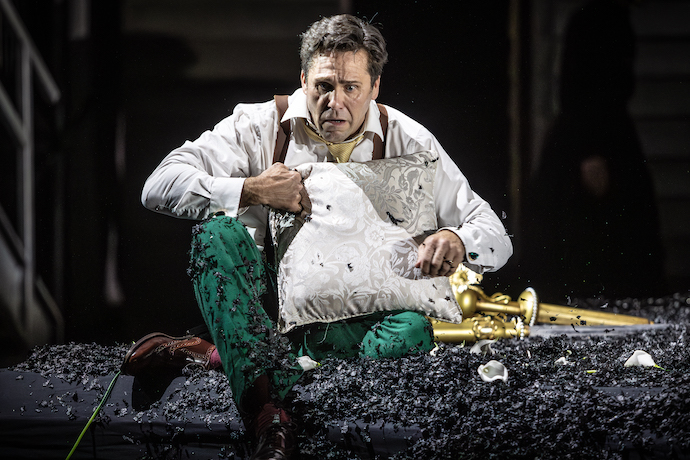
Lyon’s own story is an enviable one—judging by appearances. At 18, he won a choral scholarship to Cambridge, later earning places at the Royal Academy of Music and the National Opera Studio. Since then, he has sung with most of the country’s main opera companies—as well as on numerous international stages—often taking on leading roles. In 2022, he won rave reviews for his portrayal of the title character in Monteverdi’s Orfeo at Garsington Opera. This June, he will return to Garsington to sing Ulysses in the same composer’s Il ritorno d’Ulisse in patria.
Could his success potentially intimidate clients struggling with self esteem? Lyon insists that he is as susceptible as anybody to despondency and self doubt. “We are all our own petri dish. I’m a gay man, which is a complex thing in itself when it comes to feelings of inclusion. I went to boarding school at eight, so that had quite a profound impact on my sense of attachment. I attended Harrow, which is quite a posh school, and, being from the North, I didn’t really fit in. Then I found singing and was good at it, so people stopped teasing me and it became my life raft.”
Yet he maintains that his “life raft” can become a “torture instrument” when it springs a leak. “What happens, for example, when you’re being compared to other singers? What happens when the audience doesn’t applaud?” He continues: “Last month I was performing in Rome, and it was not a joyful experience. I had a very dubious reception from the Italian press, and it pressed a lot of my buttons.”
I don’t actually want to be talking about myself all the time. I think that might be one of my flaws as a performer
Ed Lyon
Facing these continual challenges, he says, has helped him to ask pertinent questions: “When it comes to applause or external validation, we’re really talking about attachment: what did Mum think of you? Did she make you feel good? Did you have to impress her and Dad? Were you competing with your siblings for attention? Were you bullied at school?” He likens the relationship between a performer’s self-esteem and the audience’s reception to a coercive marriage: “You’ll get to the point where you think, ‘I’m done. I’m leaving, I’ve had enough.’ Then suddenly you’ll do a gig that is so wonderful and so fulfilling, and you’ll think, ‘Oh, you do love me, don’t you?’”
So how do you help someone to break that cycle? “Sometimes the solution is to get out [of a performing career]. But often the change we have to make is to start asking for different things from the profession: ‘Have I done the work? Have I performed to the best of my abilities that day, given what has been happening in my life? Have I been kind to my colleagues?’” For Lyon, personally, the key to reducing the pressure on his music-making was adding another string to his bow: “Even though I don’t earn very much doing my therapy work, the very fact that I can earn money through it means, well, that there’s something else I do now.”
He notices that people treat him differently depending on which job he mentions first. “When I introduce myself as a singer, they say, ‘That’s amazing. Where have you sung? What music do you sing? What’s it like?’ But when I say I’m a therapist, they reply, ‘Oh, that’s really interesting.’ Then they start talking about themselves.” Is that hard to stomach, as an opera star? “No, I love it, because I don’t actually want to be talking about myself all the time. I think that might be one of my flaws as a performer.” He expands: “During the pandemic, it was fascinating to see which performers were immediately performing in gardens or posting online videos of themselves singing. At the time, I thought, ‘What are you doing?’ Without belittling the very real existential issues of COVID, for me it was a relief just to shut up for a few weeks.”
He insists that he feels “more valued when I am listening to somebody else than I do when somebody else is listening to me, particularly in our increasingly secularised society.” Why so? “At a time when fewer people go to priests to talk about [their troubles], I think counsellors and psychotherapists inhabit quite an important space.” He breaks into a laugh. “I hope it doesn’t look like I think I’m some sort of guru; I recognise that we are all flawed. But our flaws are what make us human, and help others to know that we understand what they are going through.”
For him, retraining as a psychotherapist has yielded tough insights—about himself as much as those he works with. He cites Alan Downs’s The Velvet Rage as a seminal text that shaped his thinking about the experience of growing up gay: “Downs highlights how often gay people become overachievers or work at the extremes, striving to be the best-looking, the most outrageous, or to wear the most flamboyant clothes—the idea being that if you’ve hidden something fundamental about yourself, you compensate by making yourself so valuable in other ways that it outweighs what you feel is ‘missing’ about you. I found that a very helpful lens for thinking about performers.”
Has all this self-knowledge enhanced his confidence as a singer? Yes and no, he says. “Sometimes we assume that [therapy] is like a pill you take: it makes [all your problems with confidence] go away. In fact, they keep coming back.” That said, he now feels better equipped to cushion the blows of self-doubt. “There was one time when I was singing at Carnegie Hall, thinking I was a piece of shit. And I tried to imagine an eight-year-old me or even a 14-year-old me at the back of the hall, watching. I wondered whether he would have deemed that [future vision of himself] enough.” And would he? Lyon smiles gently. “He probably would have thought it was pretty awesome, actually.”